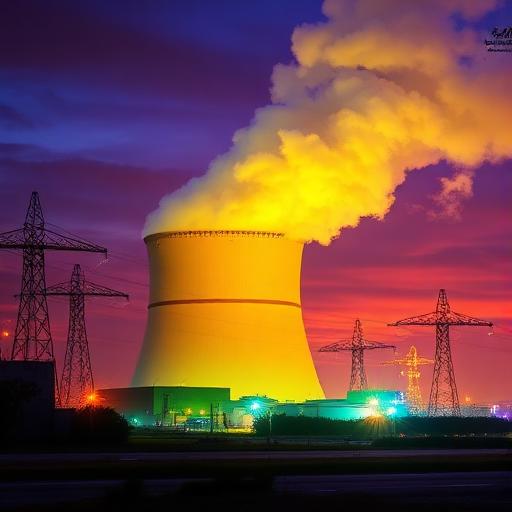
Have you ever wondered how a tiny uranium pellet, roughly the size of a peanut, can be powerful enough to supply electricity to thousands of homes for an entire year? Can such a small object truly contain such dangerous energy? Behind this incredible power lies one of the world's most complex and dangerous processes ever developed by humanity.
The Hidden World of Nuclear Fuel Production
Today we journey into a hidden world where an ordinary-looking rock extracted from deep within the Earth is transformed through high-tech machines, dangerous chemicals, and extreme conditions into nuclear fuel. Every step in this process requires precision, every procedure demands control, and every small mistake can become the cause of a major catastrophe.
This is the complete truth about enriched uranium, from its journey buried beneath the ground to its final destination inside nuclear reactors. The transformation involves multiple stages of refinement, each more critical than the last, ultimately producing one of the most energy-dense materials known to science.
The Historical Discovery of Uranium
Let's travel back in time to the year 1789, when a German scientist named Martin Heinrich Klaproth first identified uranium as a chemical element. At that time, it was considered just an ordinary metal. Nobody had any idea about the terrifying power hidden inside it. For many years, uranium remained merely a scientific curiosity.
The story continued when Marie Curie and her husband Pierre Curie advanced this research further, discovering new radioactive elements like radium and polonium. Gradually, scientists began to understand that within matter lies a source of energy that, if controlled, could change the entire world.
The Scientific Breakthroughs That Changed Everything
A major turning point came in 1932 when James Chadwick discovered the neutron. This subatomic particle had no electric charge, but its power was immense. This neutron would later become the key to nuclear fission, unlocking possibilities that scientists had only dreamed about.
Just a few years later, in 1938, German scientists Otto Hahn and Fritz Strassmann conducted an experiment that would reshape human history. They discovered that when neutrons are fired at uranium atoms, the atoms split apart, and in this process, a massive amount of energy is released. This phenomenon was called nuclear fission, and this is where the real story of nuclear energy began.
Understanding Uranium Isotopes
Natural uranium is not uniform in composition. It contains two main isotopes. The first is Uranium-238, which makes up approximately 99.3% of natural uranium. The second is Uranium-235, which constitutes only 0.7% of the total.
However, the truly useful isotope is Uranium-235 because it undergoes fission easily, while Uranium-238 remains mostly stable. This means that if we want to harness nuclear energy, we must increase the proportion of Uranium-235. This process is called uranium enrichment, the artificial increase of the Uranium-235 percentage in natural uranium.
The Manhattan Project and Nuclear Weapons Development
Imagine World War II, when the entire world was engulfed in conflict. During this time, the United States launched a secret initiative known as the Manhattan Project, where the world's greatest scientists worked together toward a common goal. Their objective was to enrich uranium and create a weapon whose power had never been witnessed before.
This project included brilliant scientists like Enrico Fermi and Robert Oppenheimer. They developed techniques to separate uranium isotopes, including gaseous diffusion and centrifuge technology. The result of this research was the atomic bomb dropped on Hiroshima, which shook the entire world and demonstrated the terrifying potential of nuclear energy.
The Shift Toward Peaceful Applications
After witnessing the destruction caused by nuclear weapons, the world began to view nuclear energy from a new perspective. The focus shifted from destruction to electricity production. The uranium used in nuclear power plants is not enriched to the same extreme levels as weapons-grade material.
For power generation, uranium is enriched only to 3% to 5%, allowing it to produce energy in a controlled manner. In contrast, weapons require enrichment levels exceeding 90%. This distinction is precisely why uranium enrichment remains one of the most sensitive and controversial technologies in the world today.
Where Does Uranium Come From?
The journey of uranium begins deep within the Earth. Uranium is found in a special mineral called uraninite, which typically occurs in very low concentrations, sometimes only 0.1% to 2%. This means that one ton of rock may contain only a few kilograms of uranium.
However, certain locations around the world contain uranium in much higher concentrations. For example, in Saskatchewan, Canada, uranium ore purity can exceed 20%, which is approximately 100 times higher than the world average. But mining in such locations presents unique challenges.
The Challenge of Underground Water
Above the uranium deposits lies a thick sandstone layer saturated with water. If this area is excavated without proper preparation, the entire mine can flood with water. This makes the mining process extremely dangerous and requires innovative engineering solutions to overcome.
Artificial Ground Freezing Technology
To tackle this challenge, engineers employ a fascinating technique called artificial ground freezing. While it may sound simple, it represents a high-tech engineering marvel that transforms the mining environment.
In this process, hundreds of deep holes are drilled into the ground, and specially designed pipes are inserted into them. Through these pipes flows an extremely cold liquid called calcium chloride brine, with temperatures reaching approximately minus 30 degrees Celsius.
Creating Ice Walls for Safety
This liquid gradually begins to freeze the surrounding ground and the water contained within it. Within a short time, the entire area transforms into a solid ice wall. This ice barrier is strong enough to completely block water infiltration and safely isolate the uranium ore, allowing the mining process to begin without any risk of flooding.
The frozen zone acts as a protective shield, enabling workers and machinery to access the valuable uranium deposits that would otherwise be inaccessible. This technique represents one of the most innovative solutions in modern mining engineering.
The Uranium Extraction Process
Now begins the actual extraction process. First, a small pilot hole is created, which guides engineers in the exact direction they need to proceed. Then, large drilling machines widen this hole, gradually reaching the uranium ore deposits deep below the surface.
Powerful drills break through the rock, and the broken material falls into collection chambers below. The most remarkable aspect of this entire process is that it is operated by remote control. Workers are not physically present at the extraction site, protecting them from radiation exposure and cave-in hazards.
Safety Measures During Mining
Additionally, fresh air is circulated inside the mine every 20 minutes to maintain a safe working environment. When the ore is brought to the surface, it is first scanned to confirm the uranium concentration it contains. In high-grade mines, this concentration can reach 15% to 18%, which is considered extremely high by industry standards.
The ore is then fed into large crushers that break it into small pieces. These pieces are ground into a fine powder, which mixes with water to form a slurry resembling wet sand. This slurry is then transported via pipelines or trucks to the processing plant for further refinement.
Chemical Processing and Purification
Now comes the chemical processing stage, where the real transformation begins. Strong acids are added to the slurry, which dissolve the uranium while other impurities settle at the bottom. This uranium-rich solution is then separated and subjected to multiple chemical reactions to increase its purity.
Gradually, this process removes impurities and prepares a highly concentrated uranium compound. Each step in this chemical journey is carefully monitored to ensure that the final product meets the strict specifications required for nuclear fuel production.
Converting to Uranium Hexafluoride
Now comes the most critical and interesting step: the enrichment process. For this purpose, uranium is converted into a special chemical form called uranium hexafluoride gas. This gas must be handled with extreme caution because it is highly reactive and poses significant safety risks if not properly managed.
The Centrifuge Enrichment Process
The uranium hexafluoride gas is sent into high-speed centrifuge machines. Imagine a machine that spins so fast that its speed reaches thousands of revolutions per minute. Inside these centrifuges, remarkable physics takes place that separates the uranium isotopes.
The heavier Uranium-238 molecules are pushed toward the outer wall of the centrifuge, while the lighter Uranium-235 molecules concentrate toward the center. This difference is extremely small, but when the process is repeated across thousands of centrifuges, the percentage of Uranium-235 gradually increases.
Cascade Systems for Higher Enrichment
This repetitive process through multiple centrifuge stages is what achieves the desired enrichment level. Each pass through a centrifuge increases the Uranium-235 concentration slightly, and by connecting hundreds or thousands of centrifuges in series, engineers can achieve the precise enrichment levels needed for nuclear fuel.
The entire system operates under strict security protocols because the same technology used for peaceful power generation could potentially be misused for weapons production. This dual-use nature makes uranium enrichment one of the most heavily monitored industrial processes on Earth.
Manufacturing Nuclear Fuel Pellets
When uranium reaches the desired enrichment level, it is converted into powder form and sent to the nuclear fuel manufacturing plant. Here, this powder undergoes several critical steps before becoming ready for use in a reactor.
First, the powder is converted into uranium dioxide. Then, using high-pressure machines, it is pressed into small cylindrical pellets. Each pellet is approximately the size of a peanut, but its energy capacity is absolutely astonishing.
The Incredible Energy Density
A single uranium pellet can produce energy equivalent to approximately 1,800 pounds of coal or 150 gallons of oil. This remarkable energy density is what makes nuclear power such an attractive option for large-scale electricity generation.
After pressing, these pellets are heated in high-temperature furnaces for approximately 24 hours to make them denser and stronger. This sintering process eliminates tiny voids inside the pellets and increases their structural strength, ensuring they can withstand the extreme conditions inside a nuclear reactor.
Assembling Fuel Rods and Fuel Assemblies
Robotic arms then place these pellets into long tubes made of zirconium metal. Zirconium is a special metal that can withstand both heat and corrosion while easily allowing neutrons to pass through, which is essential for the nuclear reaction to proceed efficiently.
These tubes are tightly sealed to create fuel rods. Multiple fuel rods are combined into a structured unit called a fuel assembly. These assemblies are later installed inside nuclear reactors, where they will spend months producing energy.
Precision Engineering Requirements
Every component in this assembly process must meet exacting specifications. The tolerances are measured in fractions of millimeters, and quality control inspections occur at every stage. A single defect could compromise the integrity of the fuel rod and potentially cause problems during reactor operation.
Inside the Nuclear Reactor Core
Inside the reactor core, thousands of fuel rods are arranged in a specific configuration designed to optimize the nuclear reaction. When the reactor is activated, neutrons collide with Uranium-235 atoms, causing the atoms to split apart in the process of nuclear fission.
During this process, tremendous heat is released, along with new neutrons that go on to split other atoms. This creates a chain reaction that sustains itself as long as enough fissile material is present and the conditions are properly controlled.
Controlling the Chain Reaction
This reaction is carefully controlled so that energy is produced at a steady, manageable rate. Control rods made of neutron-absorbing materials can be inserted or withdrawn to speed up or slow down the reaction as needed. This precise control is what distinguishes a nuclear reactor from a nuclear bomb.
The heat generated converts water into steam, and this steam drives massive turbines. These turbines are connected to generators that produce electricity. A single nuclear reactor can generate electricity for millions of people, making nuclear power one of the most efficient energy sources available.
The Dark Side: Dealing with Spent Nuclear Fuel
However, this story has a dark side as well. When fuel rods have been used for approximately one year, they become spent fuel. At this point, they remain extremely hot and highly radioactive, requiring immediate careful handling.
These spent fuel rods are placed into deep water pools immediately after removal from the reactor. These pools are approximately 25 to 30 feet deep, and the fuel rods must remain submerged for at least 10 years to allow their temperature and radiation levels to decrease to manageable levels.
The Growing Challenge of Nuclear Waste
Today, millions of spent fuel rods are stored in such pools around the world, presenting an ongoing challenge for the nuclear industry. Finding permanent solutions for nuclear waste disposal remains one of the most pressing issues in energy policy, as this material will remain hazardous for thousands of years.
Scientists and engineers continue to develop new approaches to waste management, including deep geological repositories and advanced reprocessing techniques that could potentially recover usable material from spent fuel.
Final Thoughts
So the next time you switch on a light, take a moment to consider the complex science, dangerous processes, and advanced engineering working behind that simple action. The journey of uranium from underground rock to electricity in your home represents one of humanity's greatest technological achievements.
This journey is not just a chemical process but stands as the greatest example of human intelligence, innovation, and our capacity to take calculated risks. From the discovery of uranium in 1789 to modern nuclear reactors powering cities around the world, this technology represents centuries of scientific advancement.
Every small thing in our modern world has a big story behind it, and understanding these stories helps us appreciate the remarkable complexity of the systems that support our daily lives. Nuclear energy, despite its controversies and challenges, continues to play a crucial role in meeting global energy demands while producing minimal carbon emissions.
The future of nuclear energy depends on continued innovation in safety systems, waste management solutions, and new reactor designs that promise even greater efficiency and security. As we face the challenges of climate change and growing energy needs, the knowledge gained from nearly a century of nuclear development will undoubtedly shape our energy future.